
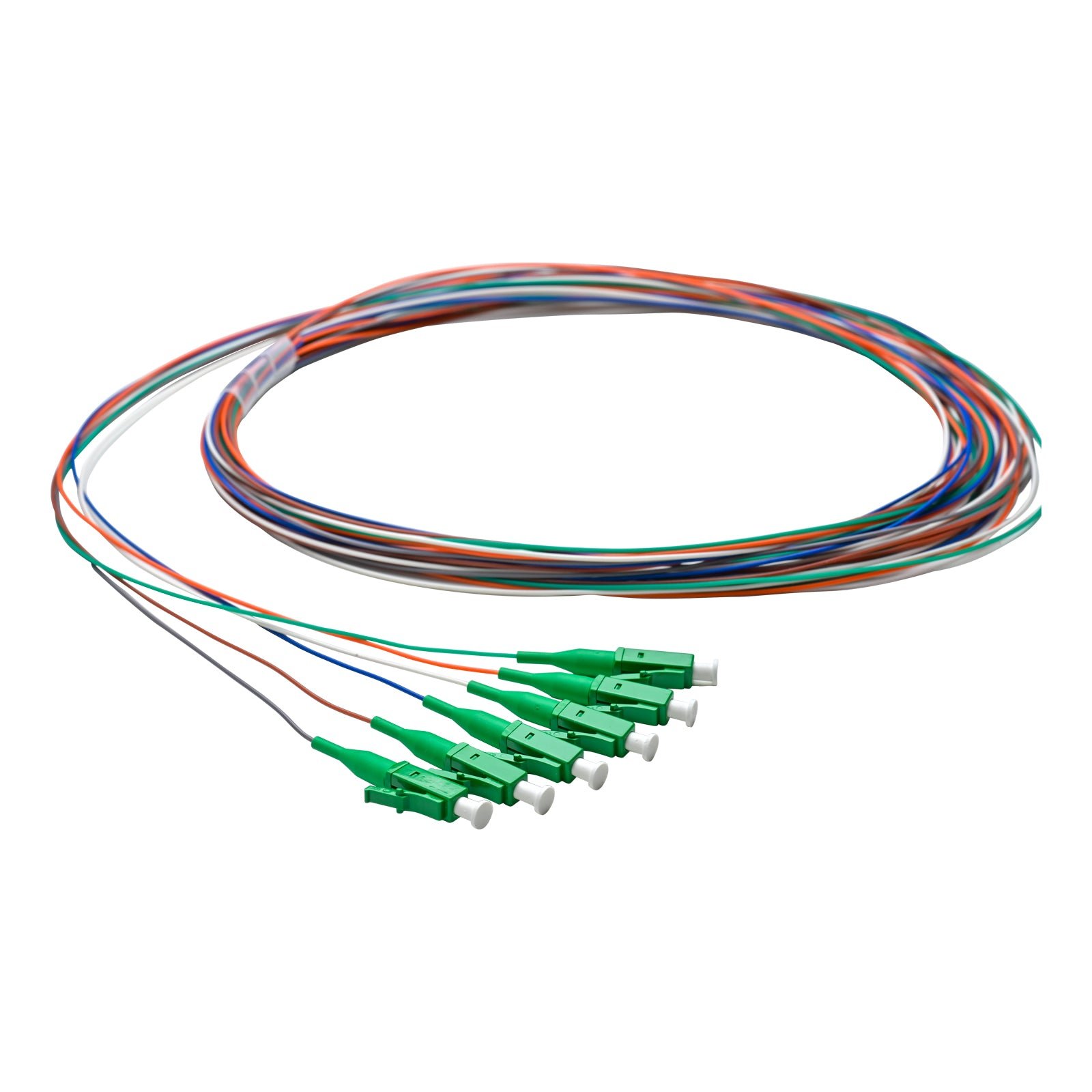
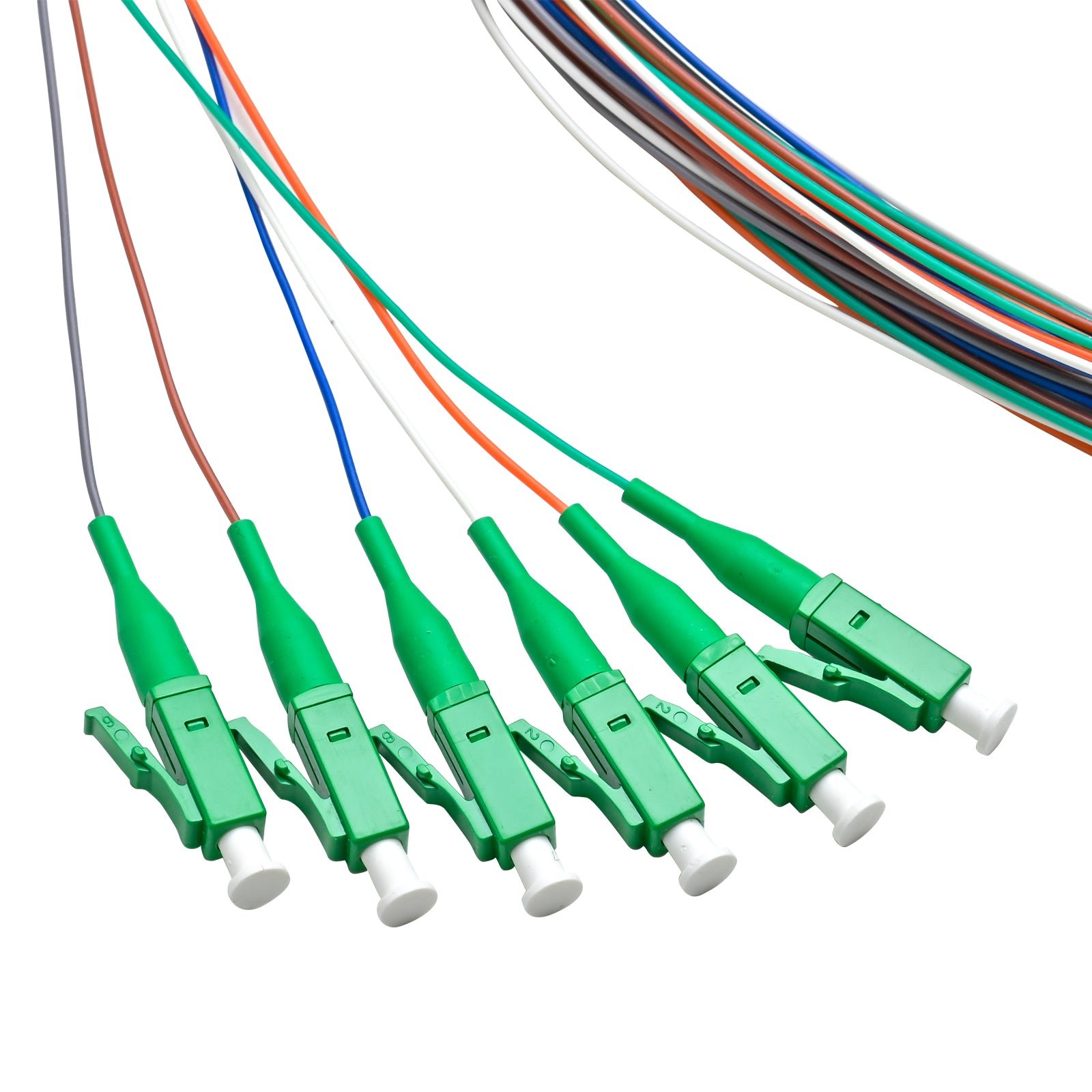
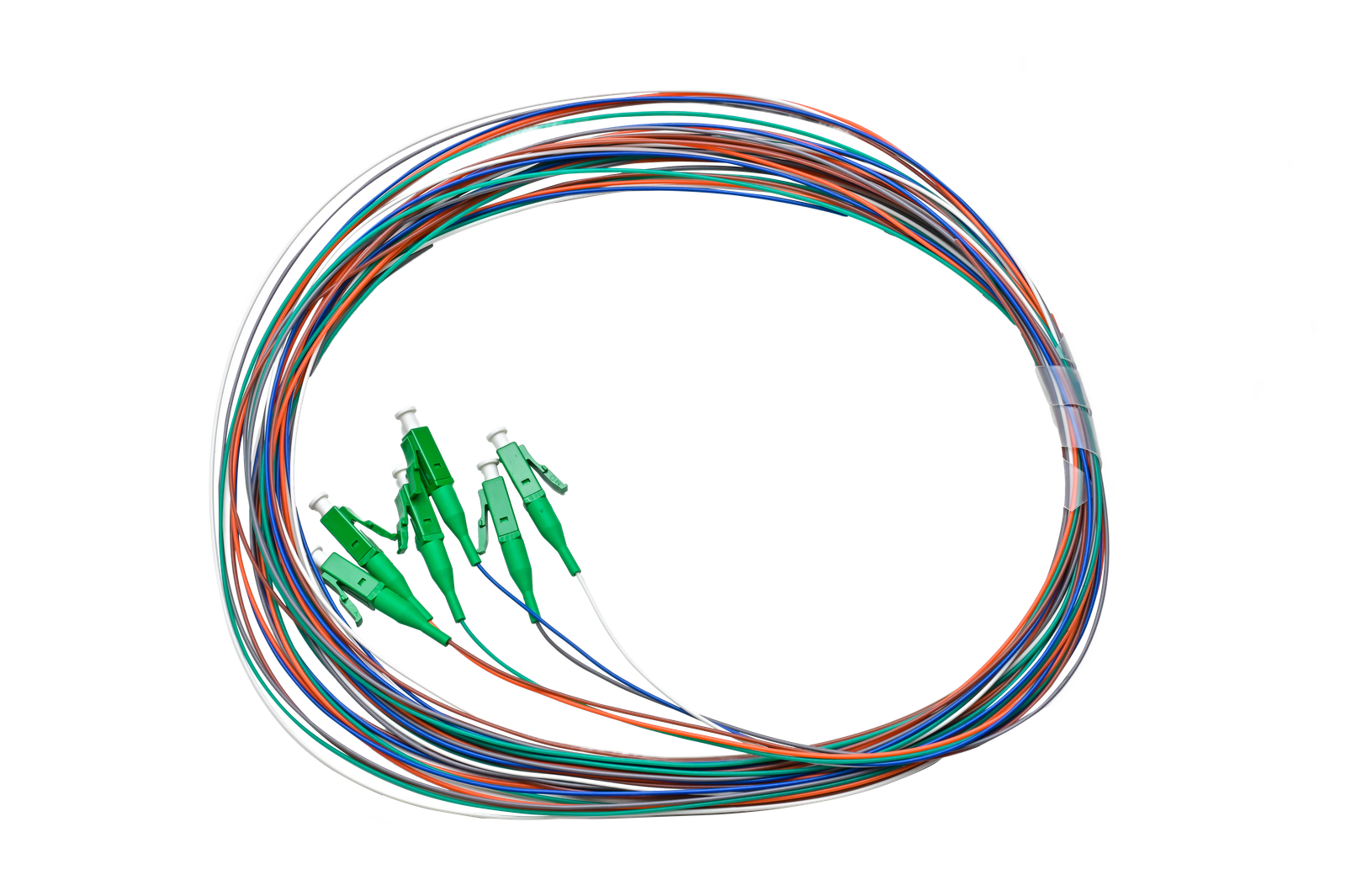
LC/APC Fiber Pigtail (Single-Mode G657A1, 3M, 0.9mm OFNR, Tight Buffer) from Red Cable Technology (RCT) — a 3-meter simplex pigtail for terminating fiber cables by fusion or mechanical splicing, built on G657A1 bend-insensitive single-mode fiber in an OFNR jacket. High-quality pigtail cable plus correct fusion splicing practices deliver the best possible termination performance, making it a natural fit for ODFs, fiber terminal boxes, and distribution boxes. Supplied in 6 colors for simple circuit identification.
Features & Specs:
- LC/APC connector, single-mode G657A1, 3 meters, 0.9mm OFNR jacket, tight buffer
- Supplied in 6 colors for easy circuit identification
- Used to terminate fiber optic cables via fusion or mechanical splicing
- High-quality pigtail cables plus correct fusion splicing practices offer the best performance possible for fiber optic terminations
- Usually found in fiber optic management equipment: ODF, fiber terminal box, and distribution box
- LC connectors are highly popular within single-mode networks, known for good performance and small size; 1.25mm ferrule (about half the size of SC), small form factor (“little connector”), designed to join LC fibers where a connection or disconnection is required
- G.657A1 is the new de facto standard for bend-insensitive NDSF SMF for premises cabling, with optimized performance and cost balance
- ITU-T G.657A1 and A2 are fully compliant with G.652D and can offer enhanced, low-loss fiber; bend-insensitive NDSF is defined in ITU-T G.657 — G.657A1 (10 µm)
- UPC connectors are polished with no angle (not exactly flat — a slight curvature for better core alignment); UPC connectors are blue while APC connectors are green
## Tight-buffered construction
Tight-buffered construction uses 900µm buffered fibers. The core is protected by a two-layer coating — the first is plastic and the second is waterproof acrylate — so the core is never at risk of exposure, unlike loose-buffered cable, which can escape its confines. Fibers are surrounded by dielectric strength members (FRP) and protected by a rugged polyurethane outer jacket, providing superior environmental and mechanical protection. The fiber count for tight-buffered fiber cable varies from 1 to 144 fibers, but generally cables with 2, 6, 12, and 24 fibers are most commonly used; larger fiber counts such as 48, 96, and 144 fibers are also available for specific applications.
## On the job
Single-mode fiber provides users with a greater transmission rate in addition to nearly 50 times longer distance than multimode fiber, though single-mode fiber is more expensive than multimode. Among all the differences between single-mode and multimode fibers, the most basic is the size difference in the fibers’ core, along with the associated loss or attenuation and fiber bandwidth. When weighing your options between on-premises and access-network fiber replacement or new installation, we recommend replacing legacy OS1 with a new bend-insensitive OS2 (ITU-T G.657A1) SMF cabling system to support longer reach with enhanced link performance.
Reviews
There are no reviews yet.