
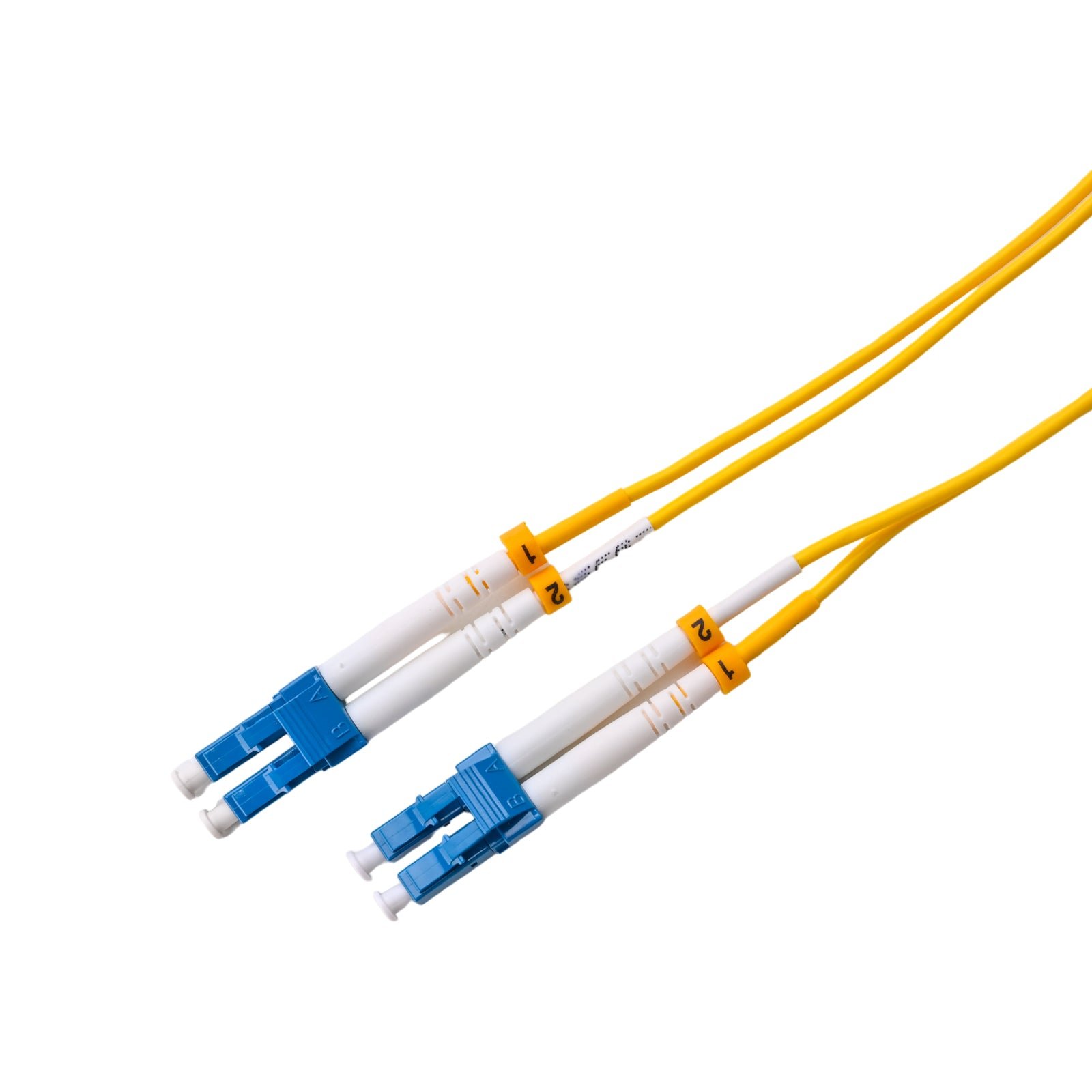
Patchcord LC/UPC – LC/UPC Singlemode OS2 9/125 G675A1 Duplex Zip 2.0 mm OFNR Yellow from Red Cable Technology (RCT) is a duplex zip patch cord with high-quality LC/UPC connectors on both ends, built on 9/125 OS2 singlemode bend-insensitive fiber. The rugged yellow 2.0 mm duplex zip-cord OFNR jacket handles well in the rack, and polarity is clearly marked with yellow polarity labels so the A/B orientation is obvious at a glance.
Features & Specs:
- LC/UPC – LC/UPC, 9/125 OS2 singlemode, duplex zip cord, 2.0 mm OFNR yellow jacket
- LC connector: highly popular in single-mode networks, known for good performance and small size; the 1.25 mm ferrule is roughly half the size of an SC — it’s often called the little connector; a small form factor (SFF) connector designed to join LC fibers wherever connection or disconnection is needed
- G675A1 bend-insensitive single-mode fiber: carries all the standard features with good resistance to macro-bending, low macro-bending sensitivity, and a low water-peak level
- Comprehensively optimized for the O-E-S-C-L band (1260–1625 nm); offers good resistance to additional losses from low macro-bending in the 1625 nm wavelength region — this supports L-band applications and allows easy installation without excessive care when storing the fiber
- Upgrade recommendation: replace legacy OS1 with a new bend-insensitive OS2 (ITU-T G.657A1) SMF cabling system to support longer reach with enhanced link performance
- For ultra-long-distance transmissions that use exclusively C-band and L-band with optical amplifiers, check the ITU-T recommendations for the most appropriate SMF type
- Multi-mode fiber is typically cost-effective inside buildings or corporate campuses, while single-mode suits longer distance runs; single-mode transmits over greater distances but usually needs more expensive equipment; multi-mode stays cost-effective where lengths don’t exceed a few hundred meters
## About the ITU
The International Telecommunication Union (ITU) is the United Nations specialized agency for information and communication technologies (ICTs). Founded in 1865 to facilitate international connectivity in communications networks, it allocates global radio spectrum and satellite orbits, develops the technical standards that let networks and technologies interconnect seamlessly, and works to improve ICT access for underserved communities worldwide.
Reviews
There are no reviews yet.