
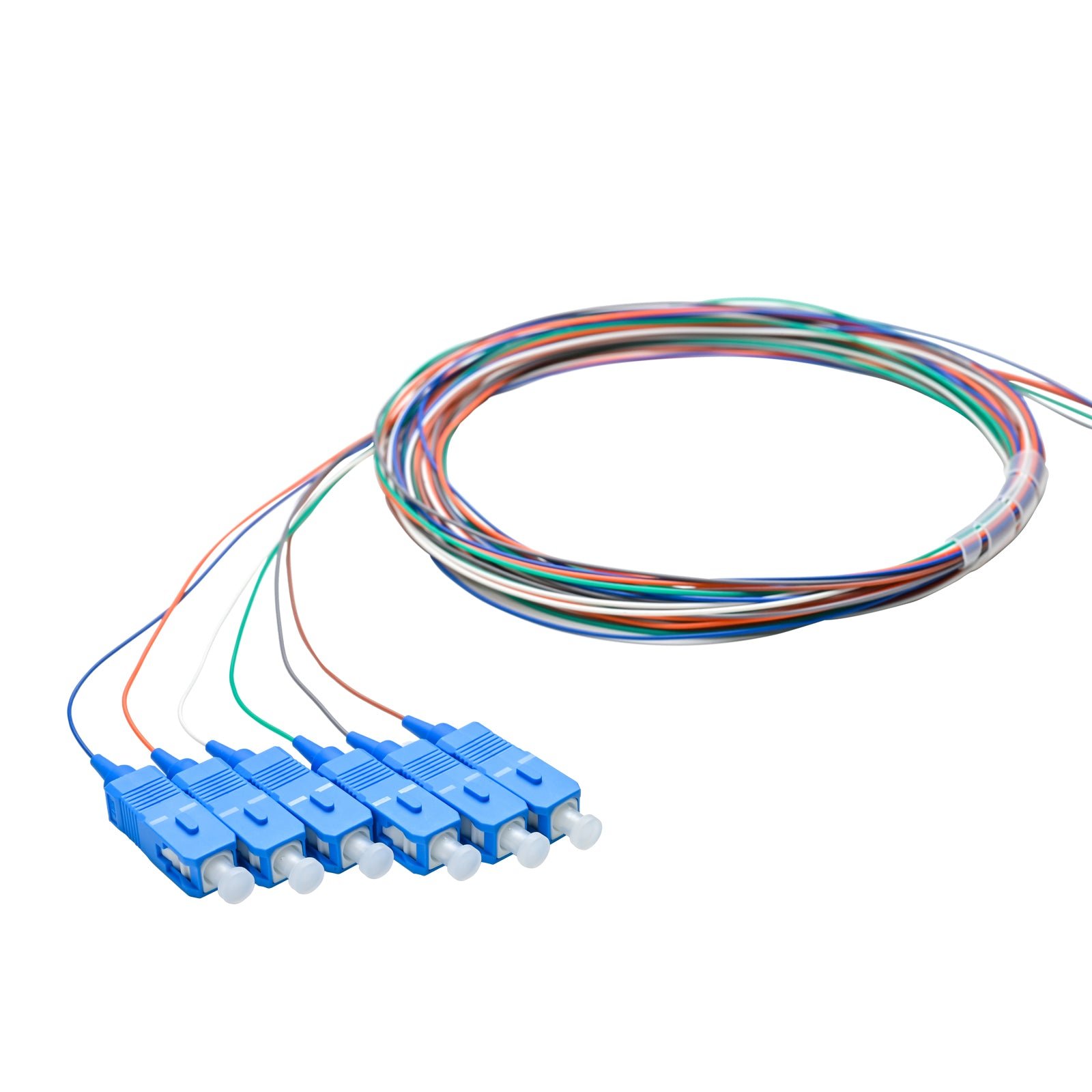
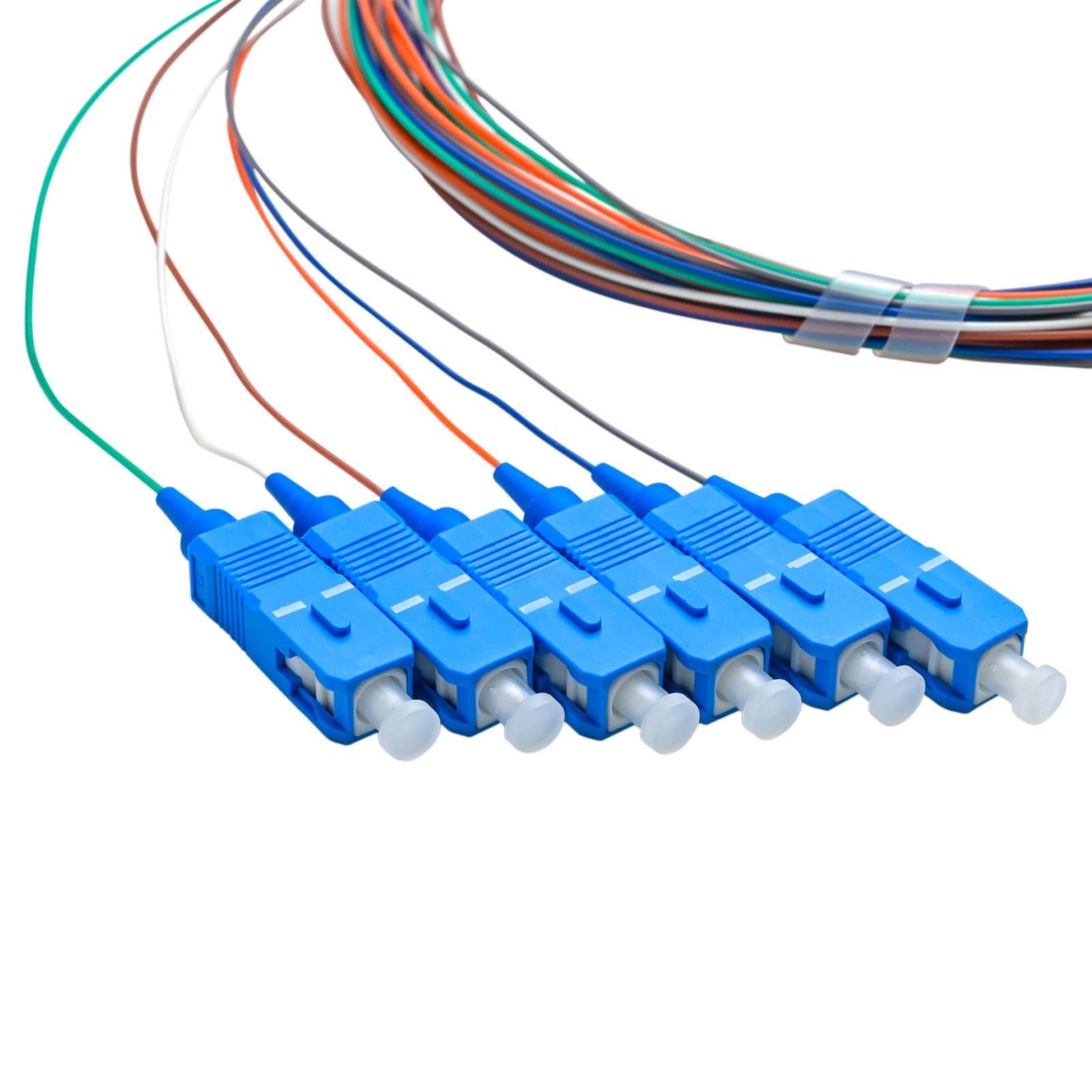
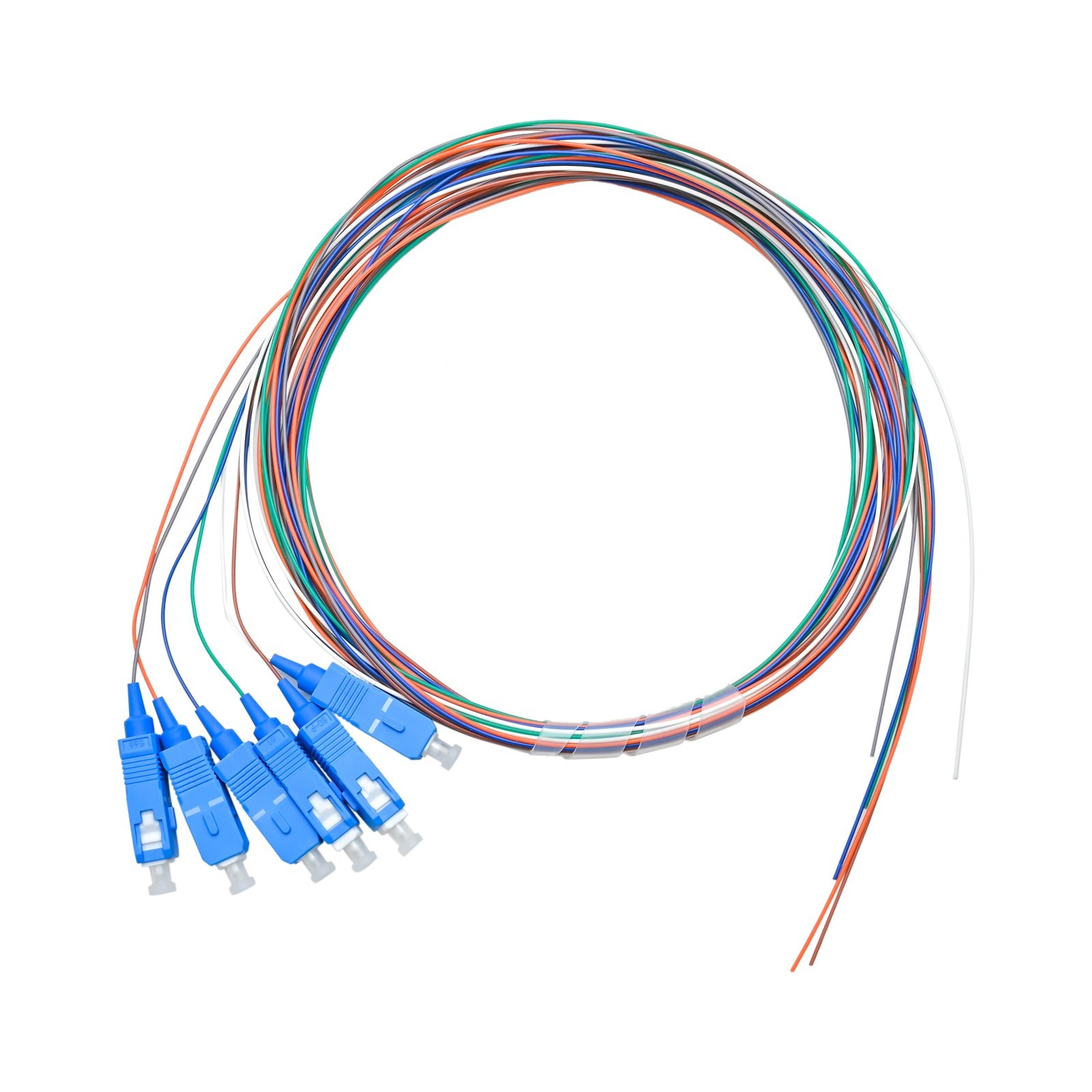
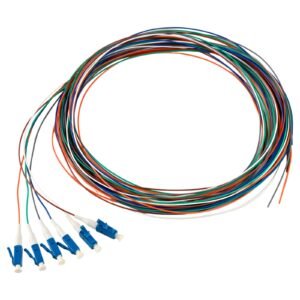
Pigtail SC/UPC 6 Colors SM G657A1 0.9mm OFNR 3M, Tight Buffer from Red Cable Technology (RCT) is a fiber optic pigtail for terminating singlemode cable by fusion or mechanical splicing, built on bend-insensitive G.657A1 SM fiber with a high-quality SC/UPC connector on a 0.9mm tight-buffered, OFNR-rated 3-meter lead. Six color-coded leads keep panel work organized.
Features & Specs:
- Use: terminate fiber optic cables via fusion or mechanical splicing; high-quality pigtail cable plus correct fusion splicing practices give the best possible termination performance; typically installed in ODFs, fiber terminal boxes, and distribution boxes.
- Connector — SC/UPC: snap-in connector with a 2.5mm ferrule, much like the ST; known for excellent performance; simple, rugged, and low cost; push-on/pull-off operation.
- Polish — UPC: polished with no angle (not exactly flat — a slight curvature for better core alignment); UPC connectors are blue, APC connectors are green.
- Fiber: singlemode, bend-insensitive G.657A1 — the de facto standard NDSF SMF for premises cabling, chosen for its optimized performance-to-cost balance; ITU-T G.657A1 and A2 are fully compliant with G.652D and deliver enhanced, low-loss fiber.
- Bend performance: minimum bending radii can be optimized, but that trades off fiber attenuation and cost; bend-insensitive NDSF is defined in ITU-T G.657 — G.657A1 (10 µm).
- Lead: 0.9mm tight-buffered construction, 3 meters, OFNR rated, six colors.
- Tight buffer: 900µm buffered fibers with a two-layer coating — plastic first, waterproof acrylate second; the core is never at risk of exposure the way it can be in loose-buffered cable; fibers sit inside dielectric FRP strength members under a rugged polyurethane outer jacket for superior environmental and mechanical protection.
- Fiber counts: tight-buffered cable runs from 1 to 144 fibers; 2, 6, 12, and 24 fibers are the most common, with 48, 96, and 144 fibers available for specific applications.
Singlemode vs. multimode
Singlemode gives users a greater transmission rate plus nearly 50 times the distance of multimode — at a higher price. The most basic difference is core size, along with its associated loss/attenuation and fiber bandwidth.
On the job
Drop these pigtails into your ODF, fiber terminal box, or distribution box and splice with proper fusion technique for the cleanest termination. For on-premises or access-network fiber replacement — or a new installation — we recommend replacing legacy OS1 with a new bend-insensitive OS2 (ITU-T G.657A1) SMF cabling system to support longer reach with enhanced link performance.
Reviews
There are no reviews yet.