
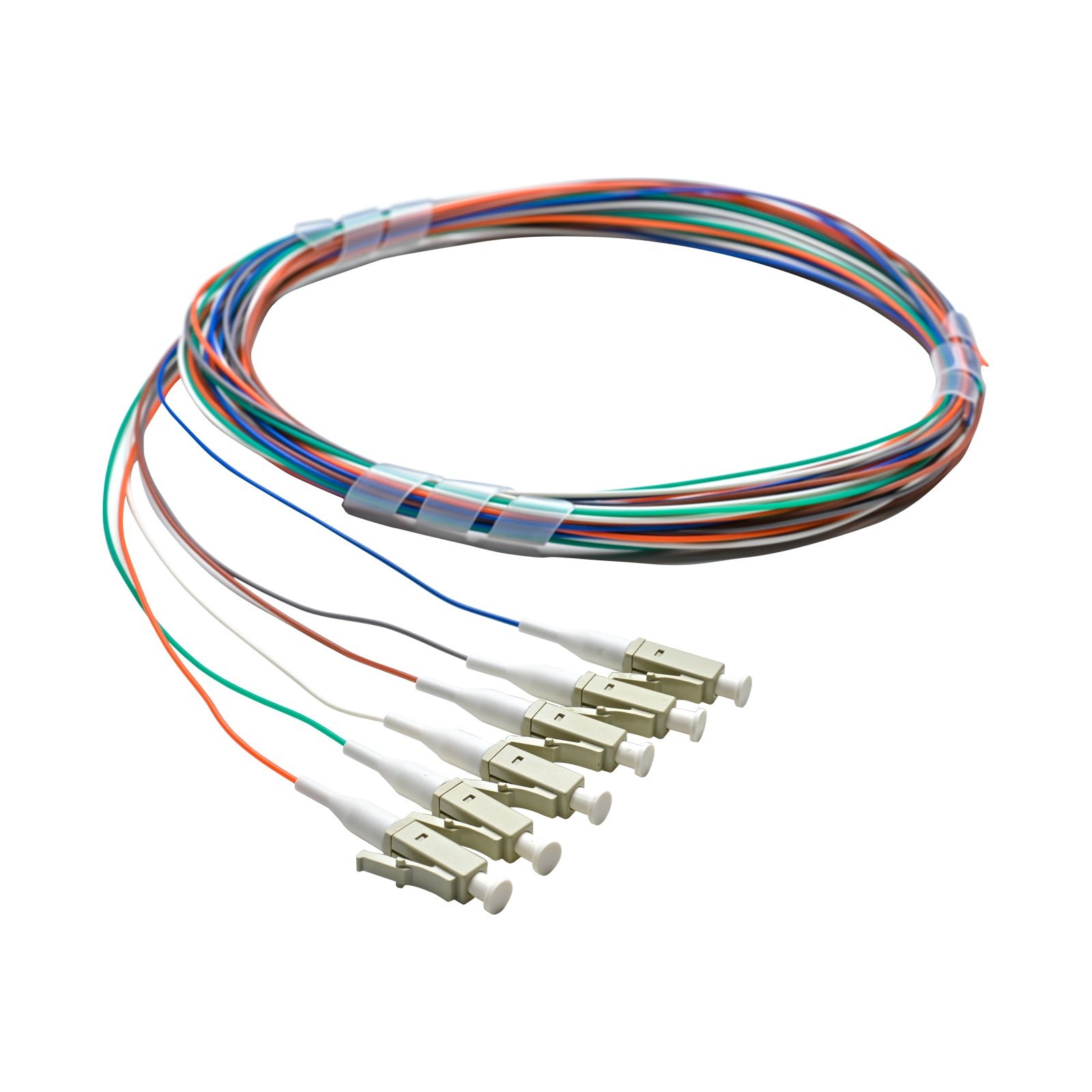
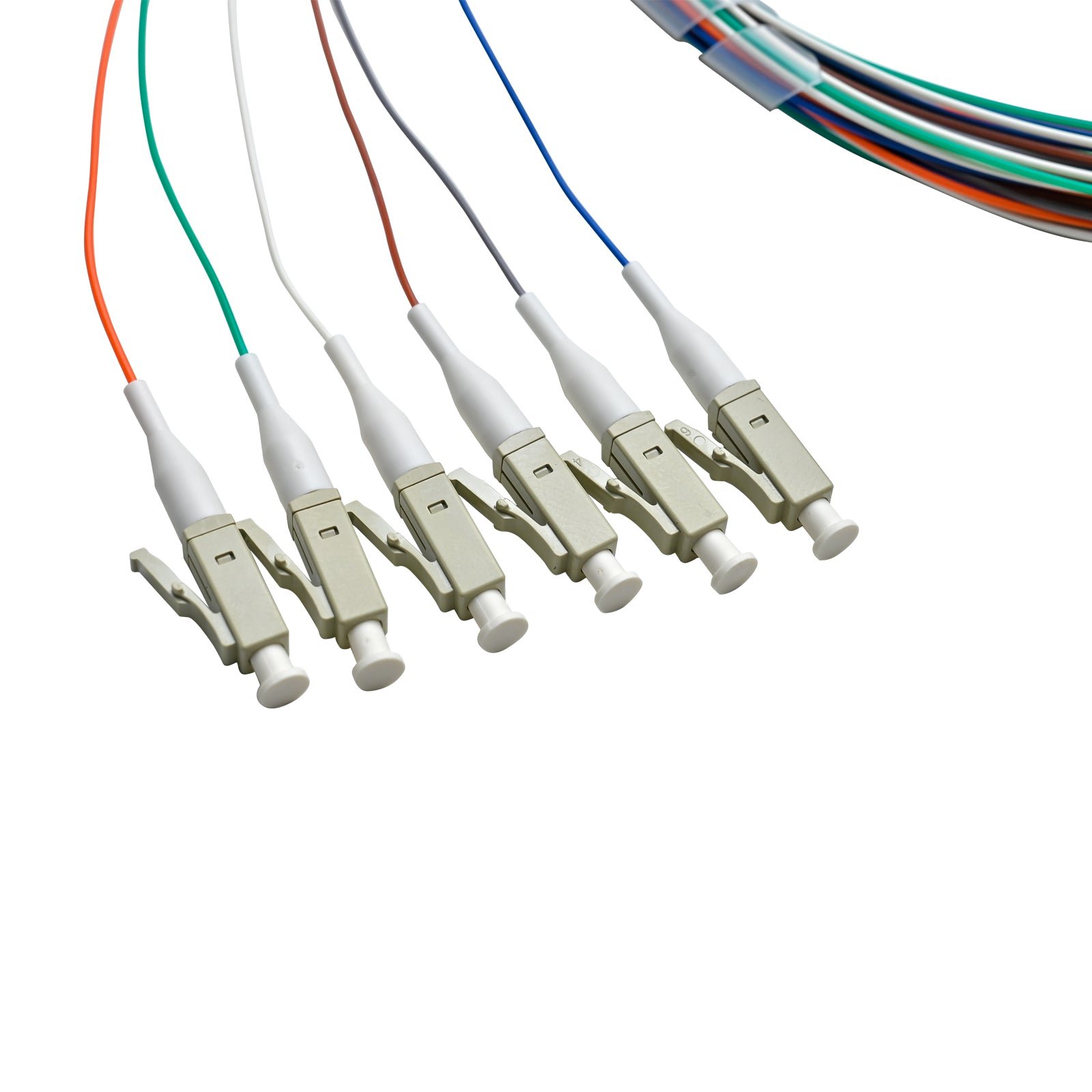
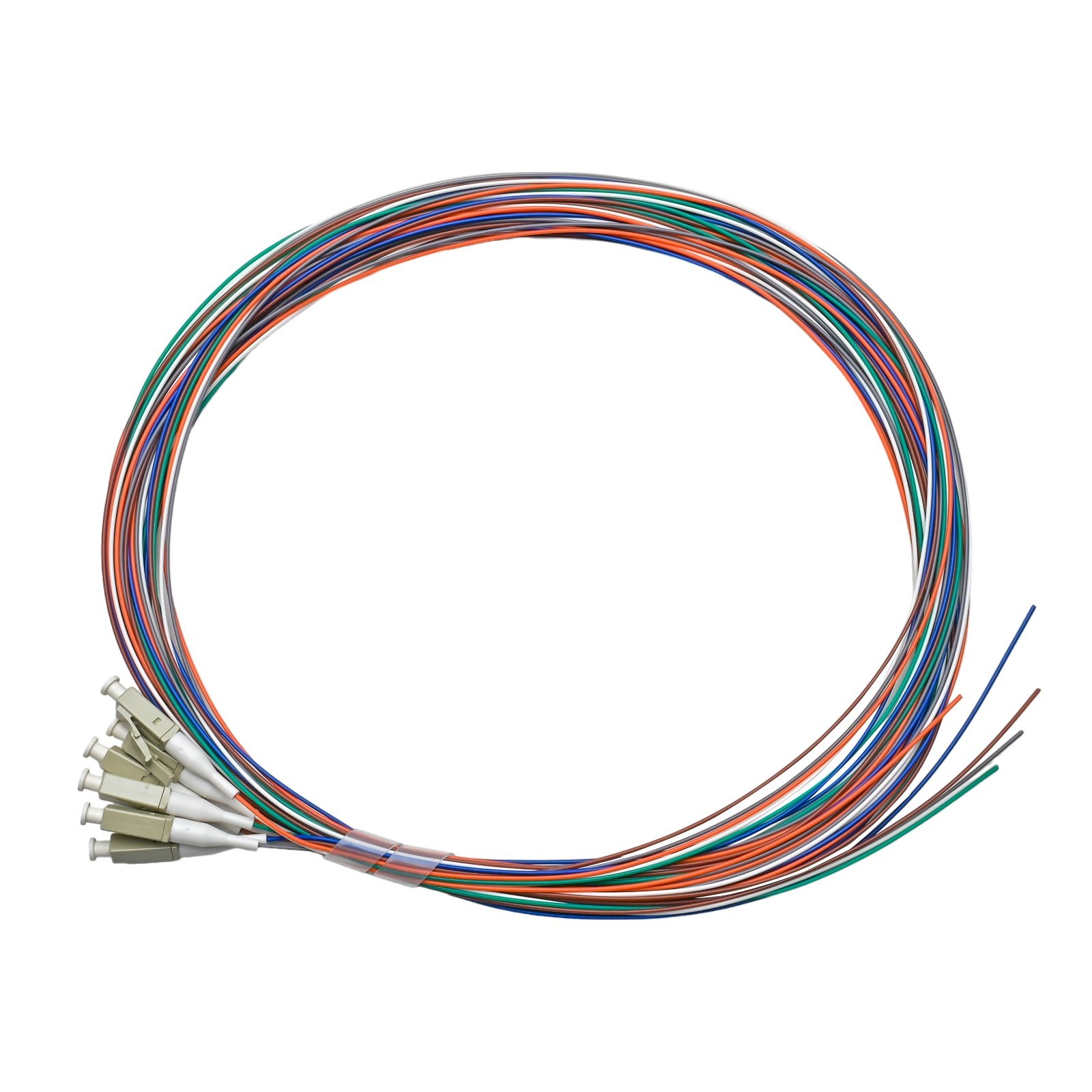
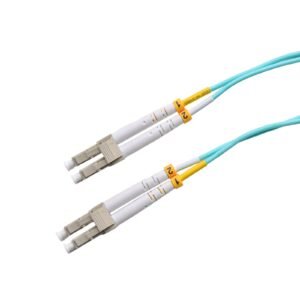
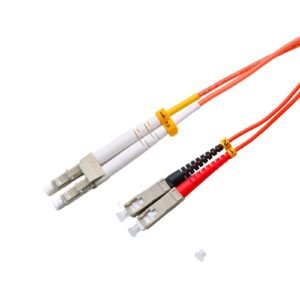
LC/UPC Fiber Pigtail (6 Colors, OM3, 0.9mm OFNR, 3M, Tight Buffer) from Red Cable Technology (RCT) — a 3-meter OM3 multimode pigtail for terminating fiber cables by fusion or mechanical splicing, in a 0.9mm OFNR tight-buffer construction. High-quality pigtail cable plus correct fusion splicing practices deliver the best possible termination performance in ODFs, fiber terminal boxes, and distribution boxes, and the 6-color set makes circuit identification simple.
Features & Specs:
- LC/UPC connector, OM3 multimode, 0.9mm OFNR jacket, 3 meters, tight buffer
- Supplied in 6 colors for easy circuit identification
- Used to terminate fiber optic cables via fusion or mechanical splicing
- High-quality pigtail cables plus correct fusion splicing practices offer the best performance possible for fiber optic terminations
- Usually found in fiber optic management equipment: ODF, fiber terminal box, and distribution box
- UPC connectors are polished with no angle (not exactly flat — a slight curvature for better core alignment); UPC connectors are blue while APC connectors are green
## About OM3 fiber
OM3 has a suggested jacket color of aqua. Like OM2, its core size is 50µm, but the cable is optimized for laser-based equipment that uses fewer modes of light. As a result of this optimization, it is capable of 10 Gigabit Ethernet at lengths up to 300 meters. Since its inception, production techniques have improved the overall capabilities of OM3 to enable its use with 40 Gigabit and 100 Gigabit Ethernet up to 100 meters. 10 Gigabit Ethernet is its most common use.
Newer deployments often use laser-optimized 50/125 µm multimode fiber (OM3). Fibers that meet this designation provide sufficient bandwidth to support 10 Gigabit Ethernet up to 300 meters, and refined manufacturing processes have produced cables that support 10 GbE up to 400 meters. Laser-optimized multimode fiber (LOMMF) is designed for use with 850 nm VCSELs.
## Tight-buffered construction
Tight-buffered construction uses 900µm buffered fibers. The core is protected by a two-layer coating — the first is plastic and the second is waterproof acrylate — so the core is never at risk of exposure, unlike loose-buffered cable, which can escape its confines. Fibers are surrounded by dielectric strength members (FRP) and protected by a rugged polyurethane outer jacket, providing superior environmental and mechanical protection. The fiber count for tight-buffered fiber cable varies from 1 to 144 fibers, but generally cables with 2, 6, 12, and 24 fibers are most commonly used; larger fiber counts such as 48, 96, and 144 fibers are also available for specific applications.
Reviews
There are no reviews yet.