
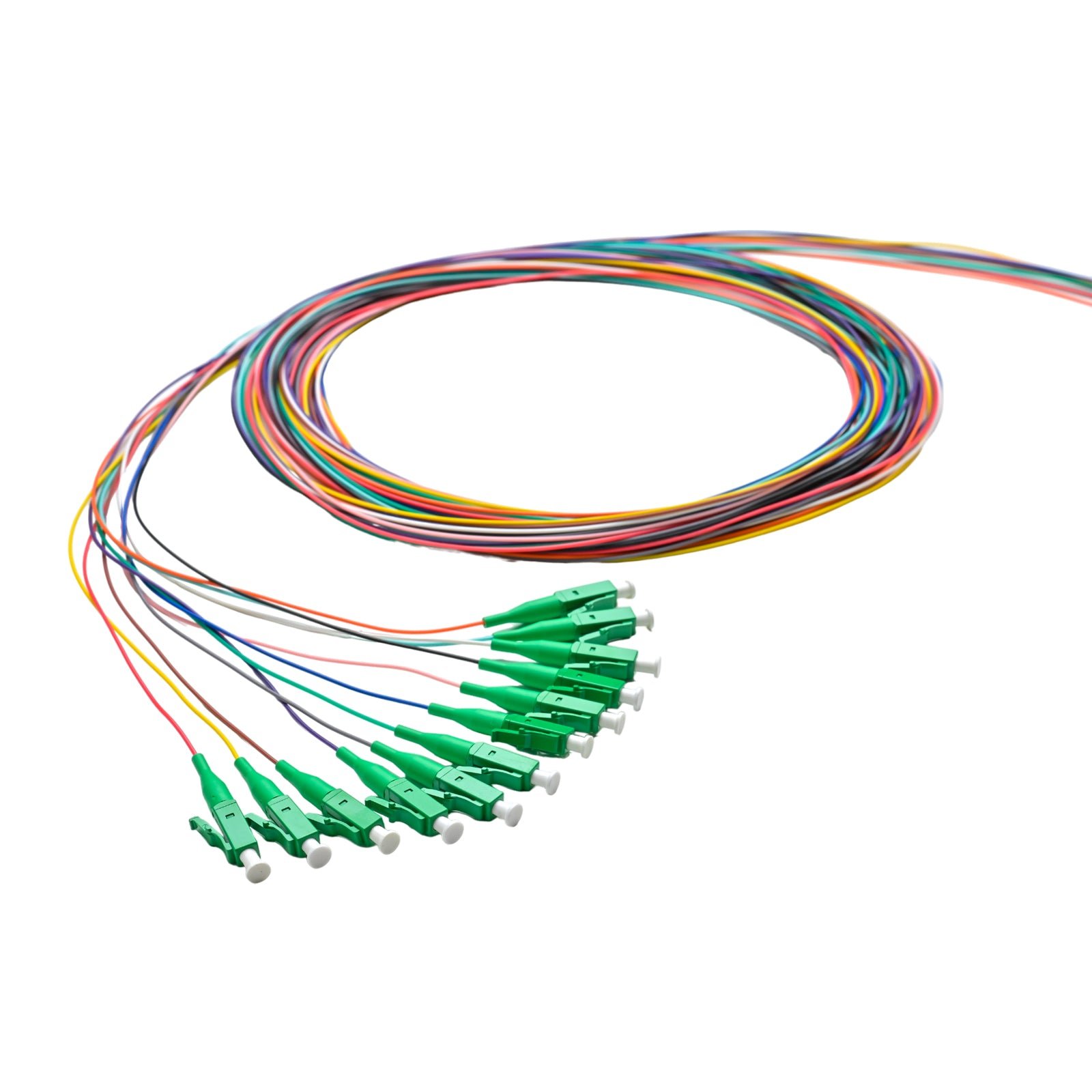
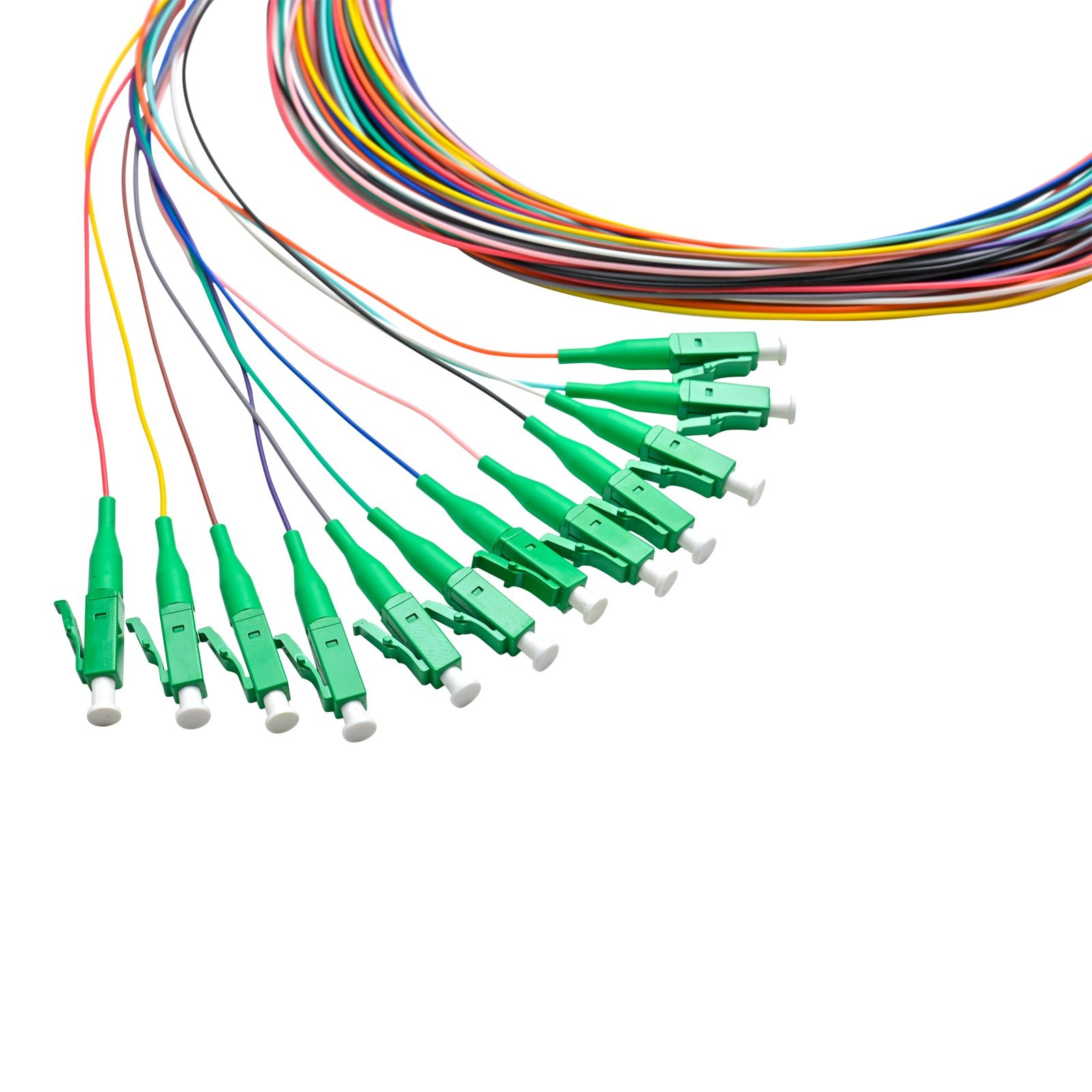
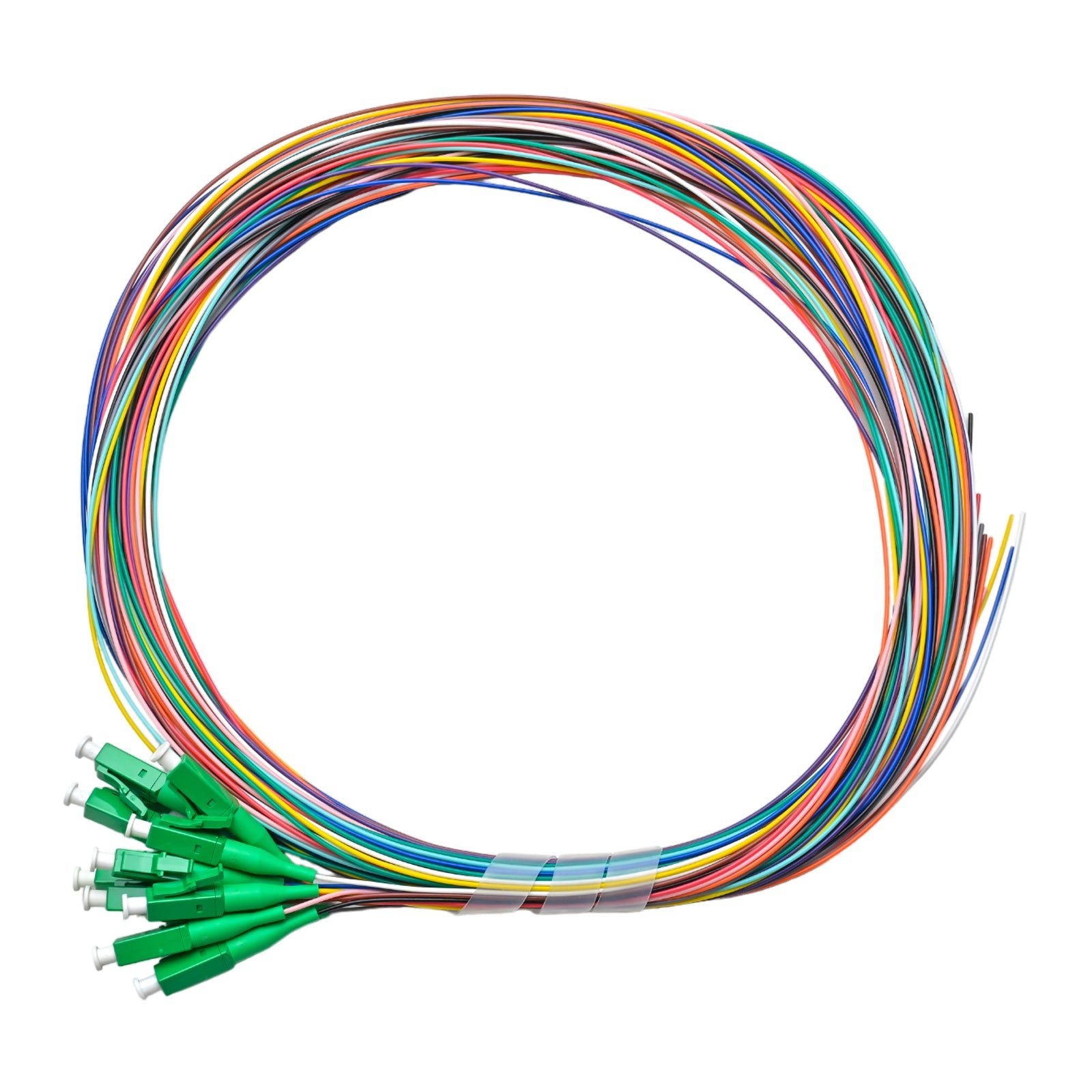
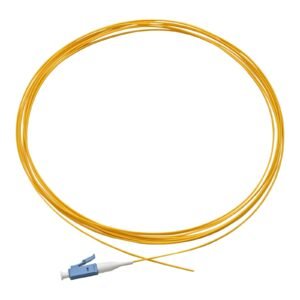
**Pigtail LC/APC 12 colors SM G657A1 0.9mm OFNR 3M, tight buffer** from **Red Cable Technology (RCT)** is a 12-fiber pigtail set made to terminate fiber optic cable by **fusion or mechanical splicing**. Each leg is terminated with an **LC/APC connector** on **bend-insensitive G.657A1 singlemode fiber**, with **0.9mm tight-buffered** construction and an **OFNR-rated** jacket in a **3-meter** length. The 12-color coding keeps fibers easy to tell apart inside ODFs, fiber terminal boxes, and distribution boxes.
**Features & Specs:**
- 12 color-coded pigtail legs for fast fiber identification in high-density terminations
- LC/APC connectors — small form factor (SFF) “little connector” with a 1.25mm ferrule, about half the size of SC; popular across single-mode networks for good performance in a small footprint
- APC (green) polish for reduced return loss in return-loss-sensitive applications
- Bend-insensitive G.657A1 singlemode fiber — the new de facto standard for bend-insensitive NDSF SMF in premises cabling, with an optimized balance of performance and cost
- ITU-T G.657A1 and A2 are fully compliant with G.652D, delivering enhanced low-loss fiber; bend-insensitive NDSF is defined in ITU-T G.657, with minimum bending radii characteristics down to G.657A1 (10 µm)
- 0.9mm tight-buffered legs, 3M length, OFNR jacket rating
- Singlemode gives users greater transmission rates and nearly 50 times the distance of multimode, at a higher cost; the most basic SM/MM difference is core size, with its associated loss/attenuation and fiber bandwidth
- Tight-buffered construction uses 900µm buffered fibers with a two-layer coating — plastic first, waterproof acrylate second — so the core is never at risk of exposure the way loose-buffered fiber can be
- Fibers sit in dielectric FRP strength members under a rugged polyurethane outer jacket for superior environmental and mechanical protection
- Tight-buffered fiber counts run 1 to 144 fibers; 2, 6, 12, and 24 are most common, with 48, 96, and 144 available for specific applications
## Built for Fusion or Mechanical Splicing
Fiber optic pigtails terminate fiber optic cables via fusion or mechanical splicing, and high-quality pigtail cable paired with correct fusion splicing practice gives the best performance a fiber termination can offer. You’ll typically find pigtails in fiber management equipment like ODFs, fiber terminal boxes, and distribution boxes.
## APC for Return-Loss-Sensitive Applications
Applications that are sensitive to return loss call for APC connectors — especially in higher optical wavelength ranges above 1500 nanometers, such as the RF video signals where reflected light can damage the signal. That’s why most cable companies and other FTTX providers use APC connectors in outside plant applications. APC is also common in passive optical applications (both GPONs and passive optical LANs), since many of those systems use RF signals to deliver video, and future higher-speed passive optical networks and other WDM applications running higher wavelengths over singlemode fiber will likely need APC’s reduced return loss too. Color cue: UPC connectors are blue, APC connectors are green.
## Replacing Legacy OS1
When weighing on-premises versus access-network fiber replacement or a new installation, we recommend replacing legacy OS1 with a new bend-insensitive OS2 (ITU-T G.657A1) SMF cabling system to support longer reach with enhanced link performance. Minimum bending radii can be optimized further, but doing so sacrifices fiber attenuation and cost.
Reviews
There are no reviews yet.