
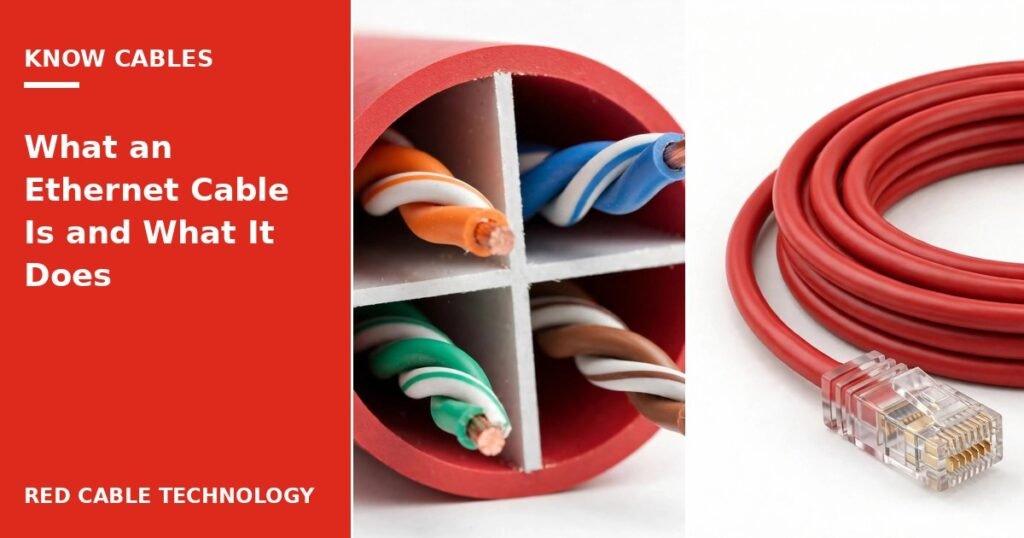
Every time a file moves from one computer to another in an office, or a camera sends its video back to a recorder, that data has to travel somehow. On a wired network it travels on an Ethernet cable. An Ethernet cable is the physical path between network devices, the wire a network actually runs on.
Carrying Data
Its main job is carrying data. Inside the cable are copper conductors, and the data moves along them as electrical signals. One end connects to a device, a computer, a printer, a camera or a phone. The other end connects to a switch, a router, or a wall outlet that leads back to them. The cable does not decide where the data goes. It provides the link, and the network equipment does the directing.
Carrying Power
It has a second job that many people do not realize. The same cable can also carry electrical power to the device at the end of it. This is called Power over Ethernet, or PoE. It is why a security camera or a wireless access point can work with a single cable and no power outlet nearby. One cable brings both the connection and the power.
What Is Inside the Cable
Look at the cable itself and it is simple in construction. Eight thin copper wires sit inside a plastic jacket. The wires are grouped into four pairs, and the two wires in each pair are twisted around each other for the full length of the run. The twisting keeps the signals clean by cancelling out electrical noise from the surroundings. Some cables add a plastic cross piece in the middle to hold the pairs apart, and some add metal shielding around the pairs. Later posts in this series cover both.
Patch Cords and Bulk Cable
How a run of Ethernet cable ends depends on where it is used. Finished short cables, called patch cords, carry a plug at each end, an 8P8C plug that everyone calls RJ45, ready to push into a device. The cable installed inside a building is different. It is supplied in bulk, in 1000ft boxes and on reels, pulled through the structure and terminated on wall jacks and patch panels, with patch cords making the final short links at each end.
Cable Categories
Ethernet cable is made in categories, and the category decides the speed it can carry and the distance it can carry it over. The common categories today are Cat5e, Cat6, Cat6a and Cat7. The next article in this series takes the four in turn.
So an Ethernet cable is two things at once: the link that joins a network together, and the path its data, and often its power, travels on. Everything else about it builds from there.