
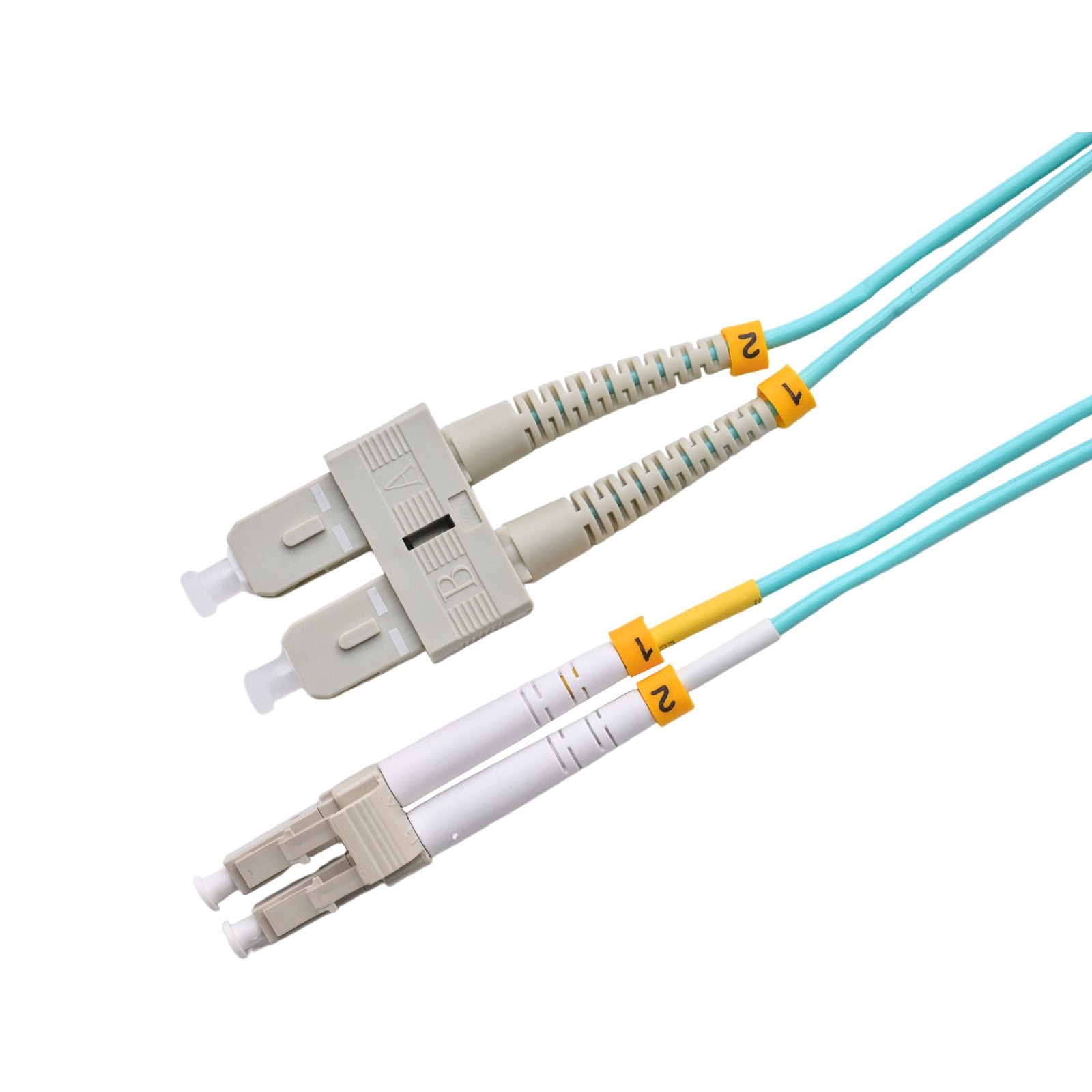
Patchcord SC/UPC – LC/UPC 50/125 Multimode OM3 Duplex Zip from Red Cable Technology (RCT) is a Shaxon fiber optic patch cord for laser-optimized multimode links, pairing high-quality SC and LC connectors with a rugged aqua 2.0mm duplex zip cord jacket rated OFNR for riser runs. Polarity is clearly marked with yellow polarity labels, and the SC connectors ship clipped — the clips can be removed in the field if you would rather run them unclipped.
Features & Specs:
- Connector A — SC/UPC: snap-in connector with a 2.5mm ferrule, much like the ST; known for excellent performance; simple, rugged, and low cost; push-on/pull-off operation.
- Connector B — LC/UPC: small form factor (SFF) connector, commonly called the little connector; 1.25mm ferrule, about half the size of SC; highly popular within single-mode networks; designed to join LC fibers where a connection or disconnection is required.
- Fiber: 50/125 µm multimode OM3; 50µm core like OM2, optimized for laser-based equipment that uses fewer modes of light.
- Jacket: aqua — the suggested jacket color for OM3 — 2.0mm duplex zip cord, OFNR rated.
- Reach: 10 Gigabit Ethernet up to 300 meters (its most common use); improved production techniques enable 40 Gigabit and 100 Gigabit Ethernet up to 100 meters; refined manufacturing can support 10 GbE up to 400 meters.
- Laser-optimized multimode fiber (LOMMF) is designed for use with 850 nm VCSELs.
Where it fits
Multimode fiber is the cost-effective pick for inside buildings or corporate campuses, where runs rarely exceed a few hundred meters. Single-mode is better suited to longer-distance runs — it transmits farther but typically calls for more expensive equipment.
Planning note
When weighing on-premises vs. access-network fiber replacement or a new installation, we recommend replacing legacy OS1 with a new bend-insensitive OS2 (ITU-T G.657A1) SMF cabling system to support longer reach with enhanced link performance. For ultra-long-distance transmissions that run exclusively C-band and L-band with optical amplifiers, check the ITU-T recommendations for the most appropriate SMF types.
Reviews
There are no reviews yet.